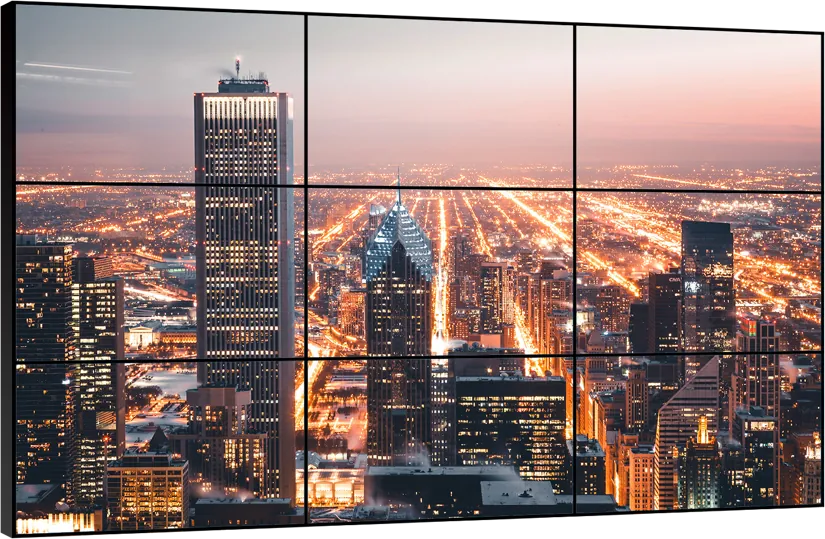
LCD video walls in showrooms and control rooms: eight project references
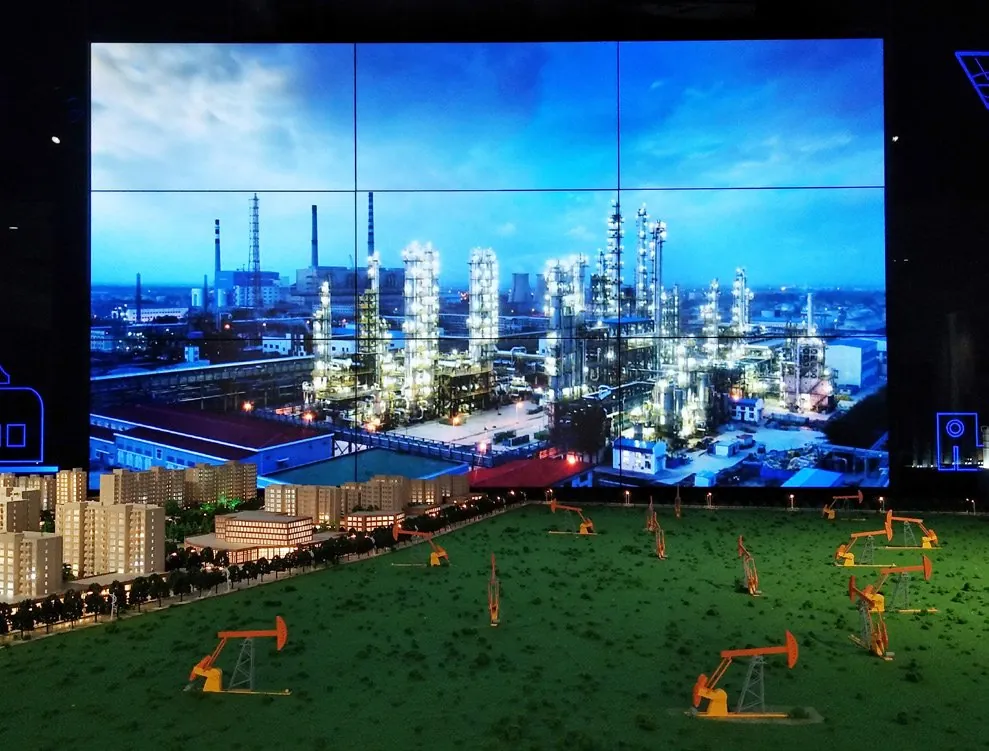
Short answer: An LCD splicing wall tiles industrial-grade panels into one large display for content a whole room must see at once. Our brochure names eight video-wall projects: a coal trading center, corporate and regional showrooms, a science park, an incubator, an industrial park and an industry pavilion. All are spaces where a building presents information to visitors or operators.
- LCD splicing walls suit showrooms, exhibition pavilions, trading centers and control rooms that need a large, sharp image at moderate cost.
- Seven of the eight brochure projects are presentation spaces (showrooms, parks, an incubator, a pavilion); one is a trading center.
- Choose 0.88 mm seams for close-up text and maps, 1.8 mm as the usual balance, 3.5 mm for distant viewing.
- Fine-pitch LED (from P1.25) has no panel seams and suits very wide walls, at a higher cost per square meter.
What an LCD splicing wall is used for
An LCD splicing wall, or LCD video wall, is a grid of narrow-bezel industrial DID panels driven as one display. Each panel is 1920 × 1080, so a 3 × 3 wall carries nine full-HD images that can be shown as one picture, as separate windows, or as a mix. Our LCD splicing panels use Samsung, LG or BOE panels with direct LED backlight and 0.88, 1.8 or 3.5 mm seams, in 46″, 49″ and 55″ sizes.
Walls like this go where many people must see the same information at once: control and monitoring rooms, exhibition and city planning halls, corporate lobbies and showrooms, and conference halls.
Eight video-wall projects named in our brochure
The video-wall section of our product brochure illustrates the product with eight project references. The brochure gives each project’s name and a photo. It does not publish wall sizes or layouts, so we do not list them here.
| # | Project | Location | Type of space |
|---|---|---|---|
| 1 | China (Taiyuan) Coal Transaction Center | Taiyuan, Shanxi | Commodity trading center |
| 2 | Nice Group (纳爱斯) showroom | Not stated in the brochure | Corporate showroom |
| 3 | Fucheng District Sci-Tech Innovation Park | Mianyang, Sichuan | Science and innovation park |
| 4 | Mianyang incubator building | Mianyang, Sichuan | Business incubator |
| 5 | Hejia Industrial Park (湖北郧西河夹产业园) | Yunxi, Hubei | Industrial park |
| 6 | Daqing industry pavilion | Daqing, Heilongjiang | Industry exhibition pavilion |
| 7 | Taiyuan showroom | Taiyuan, Shanxi | Showroom |
| 8 | Longquan showroom | Longquan, Zhejiang | Showroom |
More installation photos are on our projects page.
What these spaces had in common
Read by type of space, the list shows three things.
- They present information to visitors. Seven of the eight are showrooms, parks, an incubator or a pavilion: places where a company or a district explains its products, industries and plans to guests, investors and officials. The wall is the focal point of the visit.
- One product, many regions. The projects span Shanxi, Sichuan, Hubei, Heilongjiang and Zhejiang. A splicing wall is a repeatable product: the same panels, processor and software ship to each site and are configured for the room.
- Mixed content. A showroom wall plays a brand film full-screen, then splits into windows for maps, data and photos. A trading center shows figures that must stay readable all day. That mix is why the splicing processor matters as much as the panels.
These points come from the type of each space, not from reported results; the brochure does not publish project outcomes.
What a complete wall includes
A video wall is a system, not a stack of screens. The topology in our brochure places three control devices around the panels:
- Splicing processor: the core component. It lets images of different resolutions open in any window, overlay, zoom and roam across screens.
- Video matrix: switches several sources to the wall; each source shows on a fixed screen, one-to-one.
- Video distributor: splits one source into several identical outputs and amplifies the signal.
All of it is managed from central wall-control software. The panels accept analog and HD digital inputs, have adjustable backlight to reduce eye strain over long shifts, an all-metal anti-static housing, smart temperature control, and automatic image-retention removal for monitoring walls that show static images for hours.
Showroom wall vs control-room wall
The same product is specified differently for the two kinds of room.
| Item | Showroom or exhibition hall | Control or monitoring room |
|---|---|---|
| Viewers | Visitors standing and moving, often at a distance | Operators seated close to the wall for hours |
| Content | Brand films, maps, photos, data panels | Camera feeds, dashboards, maps, alarms |
| Seam | 1.8 mm usually; 3.5 mm if viewed from far | 0.88 mm or 1.8 mm for text crossing panels |
| Priority | Visual impact and full-screen video | Legibility, 24/7 operation, anti-image-retention |
| Often chosen | LCD, or fine-pitch LED for very wide feature walls | LCD splicing |
Our video wall bezel guide walks through the seam choice step by step.
LCD splicing vs fine-pitch LED
Fine-pitch LED builds the image from LED modules with no panel seams. Our indoor fine-pitch LED display starts at P1.25 (640,000 dots/m²) in 600 × 337.5 mm cabinets, with refresh above 3,840 Hz and front or rear maintenance at 5.5 cm total depth. The reference sheet in our brochure describes an LED wall of 19.2 × 2.36 m at 15,360 × 1,890 pixels, a width that would need many LCD panels and many seams.
| Item | LCD splicing wall | Fine-pitch LED (P1.25) |
|---|---|---|
| Seams | 0.88 / 1.8 / 3.5 mm between panels | No panel seams |
| Building block | 46″, 49″ or 55″ panel, 1920 × 1080 | 600 × 337.5 mm cabinet, 480 × 270 px |
| Viewing angle | 178° | 160°; best distance 1.5–30 m |
| Cost per m² | Lower | Higher |
| Close-up sharpness | Sharper up close | Depends on pixel pitch and distance |
| Typical rooms | Control rooms, showrooms, trading centers | Lobbies, halls, stages, very wide walls |
Choose LCD when the budget is fixed, viewers sit close or the content is text-heavy. Choose LED when seams are unacceptable, the wall is very wide, or it is the feature of a hall. One building can use both. The full range is on the video walls and LED displays page.
How to size a showroom or control-room wall
Size the wall from the room and the content, not from the largest wall that fits. A practical order of decisions:
- Start from viewing distance. Where do people stand or sit, and how close do they get? Close viewers and small text push you to a thinner seam and a denser layout; distant viewers can accept wider seams.
- Pick the layout from the content shape. Each panel is 16:9, so a 2 × 2 or 3 × 3 wall keeps a 16:9 overall shape and full-screen video fills it without black bars. Wide layouts, such as 2 × 4 or a single row, suit panoramas and timelines; our wide-format splicing wall is built for that.
- Choose the panel size. 46″, 49″ and 55″ panels change how many seams cross the image for the same wall width. Fewer, larger panels mean fewer seams.
- Count the sources. List every PC, camera, player and media box that must reach the wall, and how many windows must show at once. That sets the processor inputs and whether you need a matrix as well.
- Plan mounting and service. If there is no access behind the wall, use a front-maintenance (pop-out) bracket so a panel can be replaced from the front.
- Match the duty cycle. Showrooms often run during opening hours; control rooms run 24/7. For 24/7 walls, insist on industrial panels, temperature control and anti-image-retention.
What to send for a quote
- Room plan and the wall area available, or the layout you want (for example 3 × 3)
- Viewing distance and where viewers stand or sit
- Content types and signal sources, and how many windows must show at once
- Mounting: wall, floor stand or front-maintenance bracket
- Operating hours per day
With these, our engineers propose the panel size, seam, processor and control set. Send your room details to start.
Frequently asked questions
What kind of spaces use LCD splicing walls?
Control and monitoring rooms, exhibition and planning halls, corporate showrooms and lobbies, trading centers and conference halls. The eight brochure projects are a coal trading center, showrooms, a science park, an incubator, an industrial park and an industry pavilion.
Are wall sizes available for the brochure projects?
No. The brochure names the projects and shows photos but does not publish wall sizes or layouts, so we do not quote them. For your project we size the wall from your room and viewing distance.
Should a showroom choose LCD splicing or fine-pitch LED?
LCD splicing costs less per square meter and is sharp up close, with thin seams of 0.88–3.5 mm. Fine-pitch LED from P1.25 has no panel seams and suits very wide feature walls, at a higher cost.