LED display pixel pitch: choosing fine-pitch LED by viewing distance
Short answer: Pixel pitch is the single number that sets how sharp an LED wall looks, how close people can stand and how much it costs. Choose it in this order: the nearest viewing distance, the resolution the content needs, then indoor or outdoor, control and service access. This guide gives the general rules of thumb, shows the arithmetic, and uses the real specifications of our P1.25 LED wall so you can compare quotes on concrete numbers.
- Pixel pitch is the center-to-center distance between two pixels in millimeters; a smaller number means a denser, sharper and more expensive wall.
- Rule of thumb: the nearest comfortable viewer stands about 1 m away per mm of pitch, and 2–3 m per mm looks smooth to most people.
- Divide the wall width in millimeters by the pitch to get the pixel count: 4.8 m at P1.25 is 3,840 pixels, at P2.5 only 1,920.
- Our P1.25 indoor LED has 600 × 337.5 mm cabinets at 480 × 270 px, ≥ 600 cd/m², > 3840 Hz refresh and front or rear service at 5.5 cm depth.
1. What pixel pitch means
Pixel pitch is the distance in millimeters from the center of one LED pixel to the center of the next. "P1.25" means 1.25 mm. A smaller pitch packs more pixels into each square meter, so the image stays sharp when viewers stand closer.
Pixel density follows directly from the pitch: pixels per meter = 1,000 ÷ pitch, and pixels per square meter is that number squared. For P1.25, 1,000 ÷ 1.25 = 800 pixels per meter, and 800 × 800 = 640,000 pixels/m². That matches the 640,000 dots/m² in our brochure for the P1.25 fine-pitch LED display.
"Fine-pitch LED" usually means indoor walls at about 2.5 mm pitch or below. Each pixel is a red, green and blue LED group (1R1G1B on our P1.25 modules).
2. Pitch vs viewing distance: the rules of thumb
The industry uses two simple rules to link pitch to distance. They are rules of thumb, not guarantees: eyesight, content and brightness all shift the result.
- Minimum comfortable distance ≈ 1 m per mm of pitch. A P2.5 wall needs viewers at about 2.5 m or more before the pixel grid stops being obvious.
- Comfortable viewing distance ≈ 2–3 m per mm. At this range most people see a smooth image. A related "10 feet per mm" visual-acuity rule (about 3 m per mm) estimates where a person with normal vision can no longer resolve single pixels.
| Pitch | Pixels/m² | Minimum distance (≈1 m/mm) | Comfortable distance (≈2–3 m/mm) | Typical general use |
|---|---|---|---|---|
| P1.25 | 640,000 | 1.25 m | 2.5–3.75 m | Boardrooms, control rooms, close lobby walls |
| P1.5 | ≈ 444,444 | 1.5 m | 3.0–4.5 m | Meeting rooms, showrooms |
| P1.86 | ≈ 289,051 | 1.86 m | 3.72–5.58 m | Conference halls, lobbies |
| P2.5 | 160,000 | 2.5 m | 5.0–7.5 m | Auditoriums, ballrooms, large halls |
| P3.91 | ≈ 65,410 | 3.91 m | 7.82–11.73 m | Stages and events |
| P6 | ≈ 27,778 | 6 m | 12–18 m | Outdoor facades viewed from the street |
| P10 | 10,000 | 10 m | 20–30 m | Roadside and rooftop billboards |
Measure from the front row, the reception desk or the operator's chair, not the middle of the room. Our brochure gives a best viewing distance of 1.5–30 m for the P1.25 wall, which agrees with the 1 m per mm rule at the near end.
3. Resolution math: how many pixels your wall has
An LED wall has no fixed resolution; it has as many pixels as fit across its size. Divide the width in millimeters by the pitch for horizontal pixels, and the height by the pitch for vertical pixels.
| Wall size | Pitch | Arithmetic | Resolution |
|---|---|---|---|
| 2.4 × 1.35 m | P1.25 | 2,400 ÷ 1.25 = 1,920; 1,350 ÷ 1.25 = 1,080 | 1920 × 1080 (Full HD) |
| 4.8 × 2.7 m | P1.25 | 4,800 ÷ 1.25 = 3,840; 2,700 ÷ 1.25 = 2,160 | 3840 × 2160 (4K UHD) |
| 4.8 × 2.7 m | P2.5 | 4,800 ÷ 2.5 = 1,920; 2,700 ÷ 2.5 = 1,080 | 1920 × 1080 (Full HD) |
| 2.88 × 1.62 m | P1.5 | 2,880 ÷ 1.5 = 1,920; 1,620 ÷ 1.5 = 1,080 | 1920 × 1080 (Full HD) |
| 19.2 × 2.3625 m | P1.25 | 32 cabinets × 480 = 15,360; 7 cabinets × 270 = 1,890 | 15,360 × 1,890 (brochure example) |
Halving the pitch from P2.5 to P1.25 on the same 4.8 × 2.7 m wall gives 4 times the pixels: 8,294,400 instead of 2,073,600. It also means 4 times the LEDs, which is why cost per square meter rises steeply as pitch falls.
Work backwards when content is fixed. To show native 4K (3,840 pixels across) on a 6 m wide wall, the pitch must be 6,000 ÷ 3,840 = 1.5625 mm or finer, so P1.5 (4,000 pixels across) works and P1.86 does not. Feeding a wall a lower-resolution signal works too: the processor scales it, but fine text will not gain detail.
Cabinet size sets the steps in which a wall can grow. Our P1.25 cabinet is 600 × 337.5 mm at 480 × 270 pixels, so 8 × 8 cabinets give exactly 4.8 × 2.7 m and 3840 × 2160. Other pitches use other cabinet sizes, so confirm the cabinet before fixing the wall opening.
4. What our brochure states about our P1.25 LED wall
Our brochure lists one LED specification: a P1.25 indoor/outdoor full-color display. These are the published values; anything not in this table, ask us to confirm for your project.
| Item | Brochure value |
|---|---|
| Pixel pitch / density | 1.25 mm · 640,000 dots/m² · 1R1G1B |
| Module | 150 × 168.75 mm, 120 × 135 = 16,200 pixels, 1/27 scan, constant-current drive |
| Cabinet | 600 × 337.5 mm, 480 × 270 pixels |
| Brightness | ≥ 600 cd/m², 256-level software adjustment, 10-level gamma |
| Refresh / frame rate | > 3840 Hz · ≥ 72 frames/s |
| Grayscale / colors | ≥ 65,536 levels · 16,777,216 colors |
| Viewing | Best distance 1.5–30 m · 160° horizontal |
| Flatness | ≤ 0.5 mm between adjacent pixels; module gap < 1 mm |
| Blind-spot rate | 1/100,000 |
| Service and depth | Front and rear maintenance, wall-mounted, 5.5 cm total depth |
| Power | AC 220/380 V ±10%, 50–60 Hz; average about 150–300 W/m², max ≤ 800 W/m² |
| Environment | Operating −20 to +55 °C; storage −30 to 40 °C; 25–75% RH; ≥ IP31 |
| Lifetime | 100,000 h (at ≥ 4 h/day) |
The brochure does not list other pitches such as P1.5 or P2.5. If your distance math points to a coarser pitch, send the wall size and distance and we quote what fits.
5. Indoor vs outdoor LED
Indoor and outdoor LED differ in brightness, sealing and pitch range, not just in the cabinet.
- Brightness: indoor walls work at a few hundred to about 1,000 cd/m²; ours is ≥ 600 cd/m² and dims in 256 steps. Outdoor walls in direct sun generally need several thousand cd/m².
- Sealing: our P1.25 is rated ≥ IP31, an indoor level. Outdoor cabinets generally need IP65 at the front and sealed power supplies.
- Pitch: outdoor viewers are far away, so outdoor walls generally use P2.5 to P10 and above. Fine pitch outdoors costs more without visible gain.
Our catalog lists indoor and outdoor LED cabinets, but the brochure specification above is the indoor-level P1.25. For an outdoor LED wall, ask us to confirm brightness and IP rating in writing. If the screen is small and close to pedestrians, an outdoor LCD may fit better; see the outdoor signage guide and our outdoor digital signage range.
6. LED vs LCD splicing: when each wins
Use pitch to compare them fairly. A 55″ 1080p LCD panel is about 1,218 mm wide, so its pixel pitch is about 1,218 ÷ 1,920 = 0.63 mm, finer than P1.25. LCD therefore wins up close; LED wins on seams, size freedom and brightness.
| Situation | Better choice | Why |
|---|---|---|
| Operators seated within 1–2 m, text and maps | LCD splicing | Finer pixels; lower cost per m² |
| Feature wall in a lobby or hall, no visible lines | Fine-pitch LED | No panel seams |
| Very wide or odd-shaped wall | Fine-pitch LED | Grows in 600 × 337.5 mm cabinet steps |
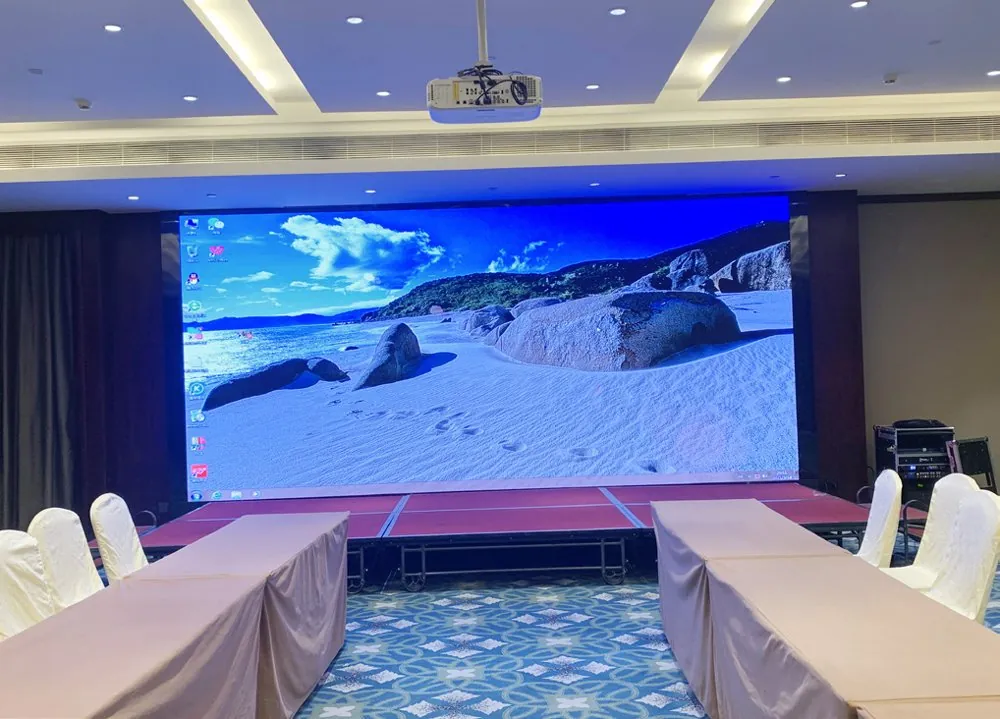
| Conference hall, ballroom or stage filmed by cameras | Fine-pitch LED | Brighter image; > 3840 Hz refresh |
| Fixed budget, 24/7 monitoring | LCD splicing | Lower cost; anti-image-retention |
The seam choice for LCD is covered in the LCD video wall bezel guide, and room-by-room examples in LCD video walls in showrooms and control rooms. Our projects page shows LED walls in a conference hall, an auditorium and a hotel ballroom, next to LCD splicing walls in showrooms.
7. Control system and content
An LED wall needs a control chain: a source, a sending device and a receiving card in every cabinet. Our brochure describes synchronous control with a DVI graphics card, a sending (data acquisition) card and receiving cards. Synchronous means the wall mirrors a computer screen in real time.
- Cabling: per the brochure, Cat5e cable up to 150 m from the control computer, or multimode fiber up to 5 km.
- Port capacity: as a general rule, one gigabit output port drives about 650,000 pixels. A 3840 × 2160 wall has 8,294,400 pixels, so it needs roughly 13 ports. Ask for the port map in the quote.
- Video processor: scales a laptop or camera feed to the wall's resolution and switches between sources.
- Asynchronous players: for walls that loop scheduled content without a PC, a player box with signage software is the alternative. See the digital signage CMS guide.
The brochure's control sheet lists older Windows versions; confirm the current controller and software version with us before ordering.
8. Installation, power and service access
Decide service access before the wall structure is built. Front service means modules come off from the front, usually with magnetic mounts and a suction tool, so the wall can sit flat on a wall. Rear service needs a walkway behind the screen, typically 0.6–1 m. Our P1.25 supports both and mounts flat at 5.5 cm total depth.
Plan power from the brochure figures. A 4.8 × 2.7 m wall is 12.96 m². At 150–300 W/m² average it draws about 1,944–3,888 W, and the circuit must cover the ≤ 800 W/m² maximum: 12.96 × 800 = 10,368 W. Leave ventilation for the 55 °C upper limit, and order spare modules from the same production batch so colors match after repairs.
9. Specification checklist for your RFQ
| Item | What to specify |
|---|---|
| Wall size | Width × height of the opening, or the target resolution |
| Viewing distance | Nearest and farthest viewer, in meters |
| Pitch | Your preferred pitch, or let us propose one from the distance |
| Location | Indoor, semi-outdoor or outdoor; sun exposure |
| Content | Video, presentations, text, camera feeds; filmed or streamed? |
| Sources and control | Number of inputs, synchronous or asynchronous, cable distance |
| Service | Front or rear access; wall, floor or hanging structure |
| Power | Voltage, phase and available circuit capacity |
| Spares | Spare modules, receiving cards and power supplies |
Send it through the contact page. The full range is on the video walls and LED displays page; samples, inspection and payment are covered in the sourcing guide.
10. Common mistakes
- Choosing pitch from a showroom demo instead of the real front-row distance.
- Buying finer pitch than the distance needs: P1.25 viewed only from 8 m looks the same as P2.5 at a much higher cost.
- Fixing the wall opening before checking the cabinet size, then losing pixels to a partial row.
- Expecting 4K from a wall too small to hold 3,840 pixels across.
- Running an indoor IP31 wall in a semi-outdoor entrance.
- Sizing the circuit for average power instead of the maximum.
- Planning rear service with no walkway behind the wall.
Frequently asked questions
What pixel pitch do I need for my viewing distance?
As a rule of thumb, allow about 1 m of minimum viewing distance per mm of pitch, and 2–3 m per mm for a smooth image. Viewers at 2.5–4 m suit P1.25; viewers at 5–7.5 m suit P2.5. Treat these as starting points, not guarantees.
How do I calculate the resolution of an LED wall?
Divide the width and height in millimeters by the pixel pitch. A 4.8 × 2.7 m wall at P1.25 is 4,800 ÷ 1.25 = 3,840 by 2,700 ÷ 1.25 = 2,160 pixels, which is 4K UHD; at P2.5 it is 1920 × 1080.
What are the specifications of your fine-pitch LED display?
Our brochure P1.25 wall has 640,000 dots/m², 600 × 337.5 mm cabinets at 480 × 270 pixels, ≥ 600 cd/m², refresh above 3840 Hz, ≥ 65,536 gray levels, front and rear service at 5.5 cm depth, and a 100,000 h lifetime.
Should I choose an LED wall or an LCD video wall?
Choose LCD splicing when viewers sit within 1–2 m, content is text-heavy or the budget is fixed. Choose fine-pitch LED when seams are not acceptable, the wall is very wide, or it is the feature of a hall or stage.