Export certifications for kiosks and digital signage: CE, FCC, RoHS, UL and more
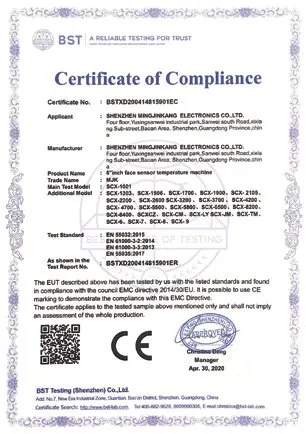
Short answer: A kiosk or digital signage display needs the marks of the country where it is sold and installed: CE (with RoHS) for the EU, UKCA or accepted CE for Great Britain, FCC for the United States, plus a UL or ETL safety listing that many North American buyers, insurers and inspectors ask for. Canada, Australia, Korea, Japan and China each have their own marks. This guide explains what each mark covers, who holds the certificate, what we already hold, and which documents to ask the factory for.
- Name the destination country first: the EU needs CE, the US needs FCC, and buyers in North America often add a UL or ETL safety listing.
- Wi-Fi, Bluetooth or 4G inside the kiosk changes the rules: CE goes under the Radio Equipment Directive and FCC needs a certified radio.
- Test reports are per model and belong to the certificate holder; ours are issued to the Shenzhen Mingjinkang entity, and certification in your name is arranged per order.
- Ask for the report, the declaration and the label drawing together, and check that the model on all three matches the unit you ordered.
1. Which marks matter in which market
Certification follows the destination, not the factory. A kiosk built in Guangdong for Germany needs CE; the same kiosk for Texas needs FCC and, in most projects, a UL or ETL listing. Name every target country in your first inquiry, because the marks decide the test plan, the label and sometimes the parts.
Three questions decide the scope for any market:
- Does it plug into the mains? Then electrical safety rules apply.
- Does it contain electronics? Then EMC (electromagnetic compatibility) and hazardous-substance rules apply. Every kiosk and signage display does.
- Does it contain a radio? Wi-Fi, Bluetooth, 4G, NFC and RFID card readers all count, and they add radio rules.
Note: this guide is general guidance, not legal advice. Rules change; confirm the requirements for your product with an accredited test lab or your customs broker before you order.
2. Market-by-market overview
The table lists the marks most often needed for a mains-powered kiosk or signage display. Industry-specific rules, such as payment or medical approvals, come on top.
| Market | Mark | What it covers |
|---|---|---|
| European Union | CE | EMC Directive 2014/30/EU, Low Voltage Directive 2014/35/EU for safety, RoHS Directive 2011/65/EU for hazardous substances. With a radio inside, the Radio Equipment Directive 2014/53/EU (RED) applies and itself covers safety and EMC. |
| Great Britain | UKCA | The UK equivalent of CE. Great Britain currently accepts CE for many product types; check the rule for your product. Northern Ireland follows CE. |
| United States | FCC | 47 CFR Part 15: emissions from digital devices, usually by Supplier's Declaration of Conformity (SDoC). Radio transmitters need FCC certification and carry an FCC ID. |
| United States | UL / ETL listing | Electrical safety, typically to UL 62368-1 for audio/video and IT equipment, tested by a Nationally Recognized Testing Laboratory. Not a federal import requirement, but often required by buyers, insurers, electrical codes and local inspectors. |
| Canada | ISED; CSA / cUL / cETL | ICES-003 for emissions, ISED certification for radios; safety certification by an accredited body is required by provincial rules for equipment connected to the mains. |
| Australia / New Zealand | RCM | Electrical safety plus EMC and radio compliance; the local responsible supplier registers on the national database. |
| South Korea | KC | Electrical safety and EMC/radio conformity under separate KC schemes. |
| Japan | PSE; Giteki (TELEC) | PSE for products and parts in the scope of the Electrical Appliance and Material Safety Act, such as many AC adapters and power cords. Radio modules need technical conformity under the Radio Act. |
| China | CCC | Compulsory certification for products in the CCC catalogue sold in mainland China. |
3. Test report, certificate and Declaration of Conformity
Buyers often ask for "the CE certificate" when what they need is a set of three different documents.
- Test report: the lab's record of measurements on one specific model against named standards. It is the evidence. It lists the model number, the tested configuration and the lab.
- Certificate of compliance: a short summary page a lab issues after a passing report. For CE under the EMC and Low Voltage Directives it is useful but not legally required; it does not replace the declaration.
- Declaration of Conformity (DoC): the legal statement, signed by the manufacturer or the party placing the product on the market, that the product meets the listed directives or rules. In the EU this is the EU DoC; in the US, for devices under SDoC, the FCC compliance statement.
Some routes need a third party by law, such as FCC certification of a radio, CCC in China or certain RED cases where harmonised standards are not fully applied. Your test lab tells you which route your product takes.
4. Who holds the certificate: factory or importer
A report is issued to the applicant named on it. If the factory paid for the test, the report is in the factory's name and covers the factory's model number.
- EU: an importer who sells the product under its own name or brand takes on the manufacturer's obligations, including the EU DoC and the technical file. That is why private-label buyers usually want the documents in their company name.
- US: for an SDoC, the responsible party must be located in the United States. An FCC ID for a radio can be held by a foreign grantee.
- Australia/New Zealand: the local importer or supplier is the responsible supplier.
As our OEM page says, reports for the base model remain valid for cosmetic changes, and certification in your own company name can be arranged per order. Our terms of sale state that this, and certification for additional markets (UL, UKCA, KC, PSE and others), is quoted separately per order.
5. What we hold today
Our products carry CE, FCC, CE-RED and RoHS test reports, and the factory is certified to ISO 9001. The full register is on the certificates page; the export-relevant entries are:
| Certificate | Standard / scope | Issued by | Reference |
|---|---|---|---|
| CE (EMC) | Certificate of compliance for commercial displays | BST Testing (Shenzhen) Co., Ltd. | Per model; report sent with quote |
| CE-RED | Radio Equipment Directive 2014/53/EU | BST Testing (Shenzhen) Co., Ltd. | Per model |
| EC declaration / RoHS | RoHS for multifunctional digital signage | BST Testing (Shenzhen) Co., Ltd. | Per model |
| FCC | Supplier's Declaration of Conformity (47 CFR Part 15) | BST Testing (Shenzhen) Co., Ltd. | Per model |
| CCC (×2) | China Compulsory Certification for display products | China Quality Certification Centre (CQC) | Copy on request |
| Energy-saving product certification | Energy-efficiency certification | CQC | Copy on request |
| Quality management system | GB/T 19001-2016 / ISO 9001:2015 | CQC; a second ISO 9001 certificate from a Beijing certification body | Copy on request |
Two points to read correctly. First, the product reports are per model: tell us the model and target market, and we send the matching report with the quotation. Second, the certificates are issued to Shenzhen Mingjinkang Electronics Co., Ltd., the company's Shenzhen entity founded in 2005, unless stated otherwise. ISO 9001 certifies the factory's quality system, not a product, so it does not replace any product mark.
The brochure spec sheet of our portable battery outdoor poster lists ISO9001, 3C, FCC and UL. UL does not appear in the certificate register, so ask for the UL file for that exact model before you rely on it.
6. How customisation affects certification
A report covers the configuration that was tested. The more you change, the more the lab needs to see again. As general guidance, confirm every case with your test lab:
- Usually no new testing: logo, color, boot screen, software and packaging. This is the core of OEM and why it carries the lowest certification risk.
- Often a review or partial retest: a different screen size in the same family, a new cabinet shape, a different mainboard or adding a wired peripheral such as a printer or scanner. Cabinet changes can affect emissions and heat; the enclosure guide covers the design side.
- Usually new testing: adding Wi-Fi, Bluetooth, 4G, NFC or an RFID reader; changing the power supply or mains input; adding a battery; moving from indoor to outdoor use.
A full ODM product is a new model and needs its own reports. The OEM vs ODM guide explains the trade-off.
7. Components with their own approvals
A kiosk is an assembly of parts, and several of them carry their own marks. Using already-approved parts makes the system test simpler, but it does not replace it.
- Power supply or adapter: the part safety labs look at first. An adapter already certified for your market saves work; changing it later usually reopens the safety file.
- Radio modules: a Wi-Fi or 4G module with its own FCC ID or RED report helps, but the host kiosk still needs its own emissions test and label wording such as "Contains FCC ID".
- Printers, scanners and card readers: many carry their own CE or FCC files. Payment terminals and card readers also need approvals from the payment network or acquirer, which are separate from electrical marks.
- Batteries: lithium batteries need transport test documents as well as product compliance.
Our kiosk peripherals article explains what each module does. Ask for the part approvals together with the system report.
8. Documents to request from the factory
| Document | What to check |
|---|---|
| Test reports per market | Model number, tested configuration, standards, lab name, applicant name |
| Declaration of Conformity | Directives or rules listed, signatory, model, whose name it is in |
| Radio module approvals | FCC ID, RED report or other national radio approvals of each module |
| Power supply approvals | Safety marks for your market on the adapter or internal supply |
| RoHS evidence | RoHS report or declaration covering the model |
| Rating label drawing | Model, voltage, power, marks, importer details, as it will be printed |
| User manual draft | Safety warnings and compliance statements in the required language |
| Bill of materials for certified parts | The part numbers that must not change without notice |
| Factory certificates | ISO 9001 and business licence, for your supplier file |
Check that the model number is identical on the report, the declaration, the label and the invoice. A mismatch is the most common reason a document set is rejected.
9. Labels and manuals
The rating label and the manual are part of compliance, not decoration. Agree them before mass production:
- Marks printed at the size and form the rules require, on the product and often on the packaging.
- Rated voltage, frequency and power that match your market's mains and plug.
- Manufacturer or importer name and address as the destination requires; in the EU and UK this usually means the importer as well.
- Radio wording such as the FCC ID or "Contains FCC ID" where a module is used.
- Safety instructions in the official language of the country of sale.
- WEEE and battery disposal symbols for European markets.
10. Plan certification into the project
Certification is easiest when it is decided with the specification, not after the sample.
- List target countries and required marks in the brief, with the exact radios and peripherals.
- Choose a base model that already has reports for your main market where possible.
- Freeze the power supply, mainboard and radio modules before testing starts.
- Test the approved sample, the same build that goes into mass production.
- Book the lab early; ask the lab, not the factory, for its current schedule.
- Keep the reports and the frozen parts list in your technical file and require notice of any part change.
The rest of the buying process, from factory checks to inspection and shipping, is in the sourcing guide. For product options see self-service kiosks and digital signage.
11. Common mistakes
- Accepting a single "CE certificate" page with no test report or Declaration of Conformity behind it.
- Using a report for a different model or configuration than the one ordered.
- Adding Wi-Fi, 4G or an RFID reader late and assuming the old report still covers it.
- Swapping the power supply for a cheaper one after testing.
- Treating FCC as enough in the US when the buyer's contract or the inspector requires a UL or ETL listing.
- Selling under your own brand without documents in your company name where the market expects them.
- Forgetting payment-network approvals for card readers, which no electrical test covers.
Send your target markets and configuration through the contact page, and we reply with the matching reports and what would still need testing.
Frequently asked questions
Do kiosks and digital signage need CE and FCC?
Yes, for the EU and the US respectively. CE covers EMC, electrical safety and RoHS, or the Radio Equipment Directive when the unit has Wi-Fi, Bluetooth or 4G. FCC Part 15 covers emissions, and radios need an FCC ID.
Is UL listing required for a kiosk in the US?
It is not a federal import requirement, but buyers, insurers, electrical codes and local inspectors often require a safety listing from a recognized lab such as UL or ETL. Check your contract and installation site before ordering.
Which certificates does MJK hold for its displays?
CE, CE-RED, RoHS and FCC SDoC test reports from BST Testing (Shenzhen) per model, two CCC certificates and an energy-saving certificate from CQC, and ISO 9001. They are issued to Shenzhen Mingjinkang Electronics Co., Ltd.
Can the certificates be issued in my company name?
Yes. Reports for the base model remain valid for cosmetic OEM changes, and certification in your company name, or for extra markets such as UL, UKCA, KC or PSE, is arranged and quoted per order.