LCD video wall vs LED video wall: how to choose for control rooms, lobbies and halls
Short answer: An LCD video wall is a grid of thin-bezel LCD panels with visible seams; an LED video wall is built from LED modules and has no seams. For control rooms that show data and small text all day, LCD splicing usually wins on resolution per metre and price; for lobbies, showrooms and halls where one seamless image matters, fine-pitch LED wins. This comparison uses the stated specifications of our 0.88 / 1.8 / 3.5 mm LCD splicing walls and our P1.25 LED display, and marks general rules of thumb as such.
- LCD splicing walls are built from 46″, 49″ or 55″ Full HD panels with 0.88, 1.8 or 3.5 mm seams; fine-pitch LED walls are seamless, built from 600 × 337.5 mm cabinets.
- At the same size, an LCD wall carries more pixels: a 3 × 3 wall of 55″ panels gives 5760 × 3240, while a P1.25 LED wall of about the same area gives 2880 × 1620.
- LED wins on seamless images, brightness (≥ 600 cd/m² on our P1.25), shape freedom and 5.5 cm depth; LCD wins on close-up detail, small text and usually price per square metre.
- Choose by content and viewing distance first, then by room light, power, service access and budget.
1. The difference in one paragraph
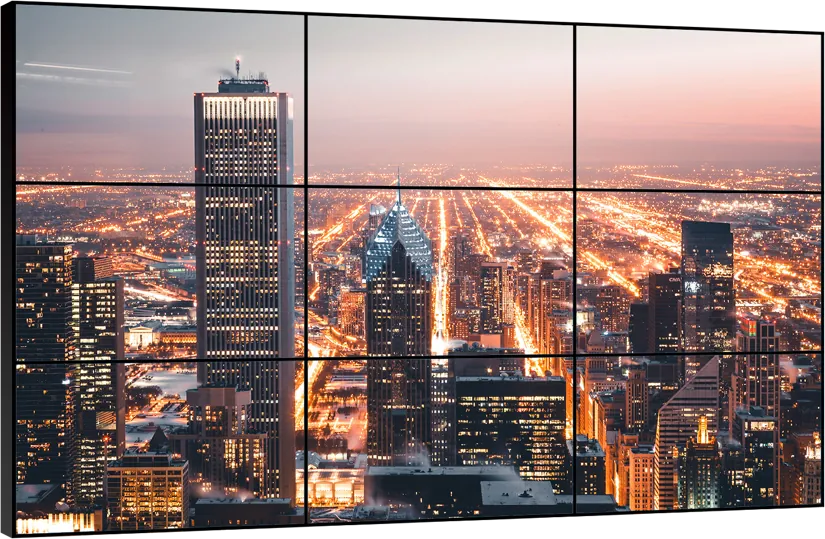
An LCD video wall (also called an LCD splicing wall or tiled display) joins several industrial LCD panels in a grid. Each panel has its own backlight and a thin frame, so the wall shows a narrow seam where two panels meet. A fine-pitch LED video wall is built from small LED modules mounted in cabinets; every pixel is a tiny LED, so there is no frame and no seam. Both are driven by a video processor that splits one picture across the wall, and both can show several sources at once.
Our range covers both: the LCD splicing video wall with 0.88, 1.8 or 3.5 mm seams, the wide-format LCD wall for panoramic lobbies, and the P1.25 fine-pitch LED display.
2. Side-by-side comparison
| Factor | LCD splicing video wall | Fine-pitch LED video wall (P1.25) |
|---|---|---|
| Seams | 0.88, 1.8 or 3.5 mm bezel-to-bezel | None; modules join without a frame |
| Building block | 46″ / 49″ / 55″ panels (Samsung, LG or BOE), 1920 × 1080 each | 600 × 337.5 mm cabinet, 480 × 270 px; 150 × 168.75 mm modules |
| Pixel density | About 0.63 mm pixel pitch on a 55″ Full HD panel | 1.25 mm pitch, 640,000 dots/m² |
| Brightness | Direct LED backlight, adjustable; ask for the panel's figure | ≥ 600 cd/m², 256-level software adjustment |
| Viewing | 178° viewing angle; sharp from close up | 160° viewing angle; best distance 1.5–30 m |
| Shape and size | Steps of one panel; 16:9 grid such as 2 × 2 or 3 × 3, or a wide matrix | Steps of one cabinet; any width and height, curves and odd sizes possible |
| Depth and service | Panels on a wall bracket or floor stand | 5.5 cm total depth; front or rear service |
| Operation | 24 h, smart temperature control, silent design, auto image-retention removal | Refresh > 3840 Hz, ≥ 65,536 grey levels; −20 °C to +55 °C |
| Lifetime | Industrial panels for 24 h use; ask for the panel's rated hours | Stated 100,000 h |
| Typical price per m² | Usually lower at this level of detail | Usually higher at 1.25 mm pitch; falls as pitch gets coarser |
The pixel pitch of a 55″ LCD panel is our own arithmetic: a 55″ 16:9 panel is about 1.218 m wide and shows 1920 pixels, about 0.63 mm per pixel. The price row is a general market observation, not a quotation.
3. A worked example: the same 3.6 m wall in LCD and in LED
Take a wall about 3.6 m wide and 2 m high, a common size for a control room or a corporate lobby.
- LCD: 3 × 3 panels of 55″. The picture is about 3.65 × 2.06 m, with two horizontal and two vertical seams. Resolution is 3 × 1920 by 3 × 1080 = 5760 × 3240, more than 4K.
- LED: 6 × 6 cabinets of 600 × 337.5 mm. The picture is 3.6 × 2.025 m with no seams. Resolution is 6 × 480 by 6 × 270 = 2880 × 1620.
So the LCD wall shows four times as many pixels in the same space, which matters for maps, dashboards, camera feeds and spreadsheets. The LED wall shows one uninterrupted image, which matters for video, brand content and presentations where a seam through a face or a logo is not acceptable. Power is another difference: our P1.25 is stated at an average of 150–300 W/m² and up to 800 W/m², so this 7.3 m² wall averages roughly 1.1–2.2 kW and needs a supply sized for up to about 5.8 kW.
4. Viewing distance and content
The closest comfortable distance decides more than any other factor:
- Operators sitting 1–3 m from the wall, reading small text and camera tiles: LCD. Its 0.63 mm pixels stay sharp up close, and our panels add automatic image-retention removal for static monitoring layouts.
- Audiences 3 m and further away, watching video or presentations: fine-pitch LED. Our P1.25 lists a best viewing distance of 1.5–30 m.
- Mixed rooms: some control rooms put an LED wall in the centre for the shared picture and LCD walls or desktop monitors for detail.
As a general rule of thumb used in LED planning, the minimum comfortable viewing distance in metres is roughly the pixel pitch in millimetres; the pixel pitch guide explains how to pick a pitch for a given room, and the bezel guide explains when 0.88 mm seams are worth the extra cost over 1.8 or 3.5 mm.
5. Room light, brightness and image
Bright lobbies with glass façades favour LED: our P1.25 is rated at ≥ 600 cd/m² with 256 software brightness levels, and it can be dimmed for darker rooms. LCD splicing panels use a direct LED backlight that can be adjusted to reduce eye strain, which suits control rooms where operators watch the wall for a full shift. For any wall facing direct sun through glass, ask for a brightness figure measured on the actual product, and for outdoor use see the outdoor signage guide.
LED refresh above 3840 Hz keeps the image free of flicker on camera, which matters in conference halls and studios that film the wall.
6. Installation, service and running costs
- Structure: LCD panels hang on a wall bracket or a floor stand; the wall must carry their weight. Our LED cabinets mount on the wall with 5.5 cm total depth, so the screen can sit almost flush.
- Service: an LED wall is serviced module by module, from the front or rear. An LCD wall is serviced panel by panel; as general practice, keep spare panels from the same batch so colours match after a replacement.
- Control: both need a processor. LCD walls use a splicing processor and matrix with windowing, overlay and cross-screen roaming; LED walls use a sending card and video processor. Ask what inputs you need and how many windows the wall must show at once.
- Power and heat: plan the electrical supply and air conditioning from the stated power figures; LED power depends strongly on the content and brightness.
7. Which one fits which room
| Room | Usual choice | Why |
|---|---|---|
| Security, traffic and dispatch control rooms | LCD splicing, 0.88 or 1.8 mm | Many camera tiles and small text; 24 h operation; resolution per metre |
| Trading floors and data centres | LCD splicing | Dashboards and figures read from desks |
| Corporate lobbies and brand showrooms | Fine-pitch LED, or wide-format LCD | Seamless brand video; panoramic layouts |
| Exhibition and city-planning halls | Fine-pitch LED | Large seamless images seen from a distance |
| Conference and lecture halls | Fine-pitch LED | Audience further away; no seam through slides |
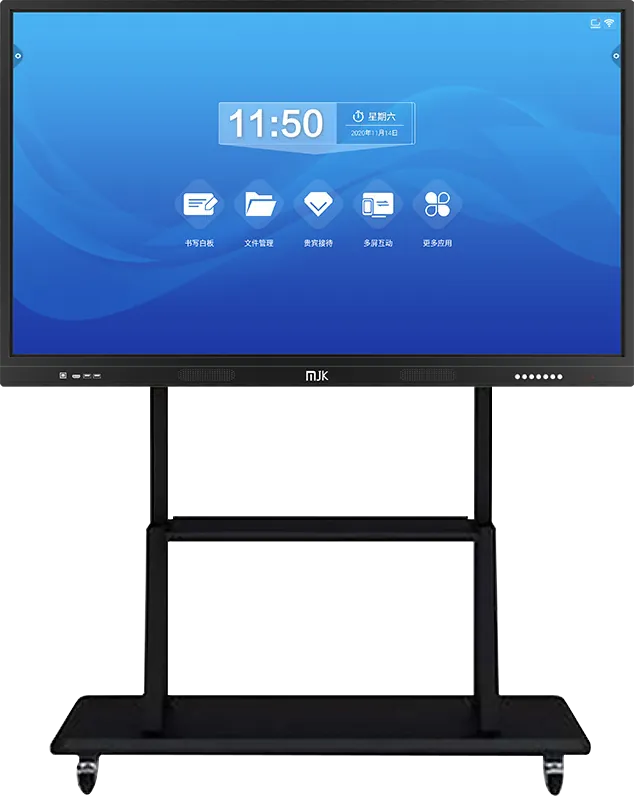
| Meeting rooms up to about 7 m deep | Interactive flat panel | One screen with touch and casting is enough; see the whiteboard vs projector comparison |
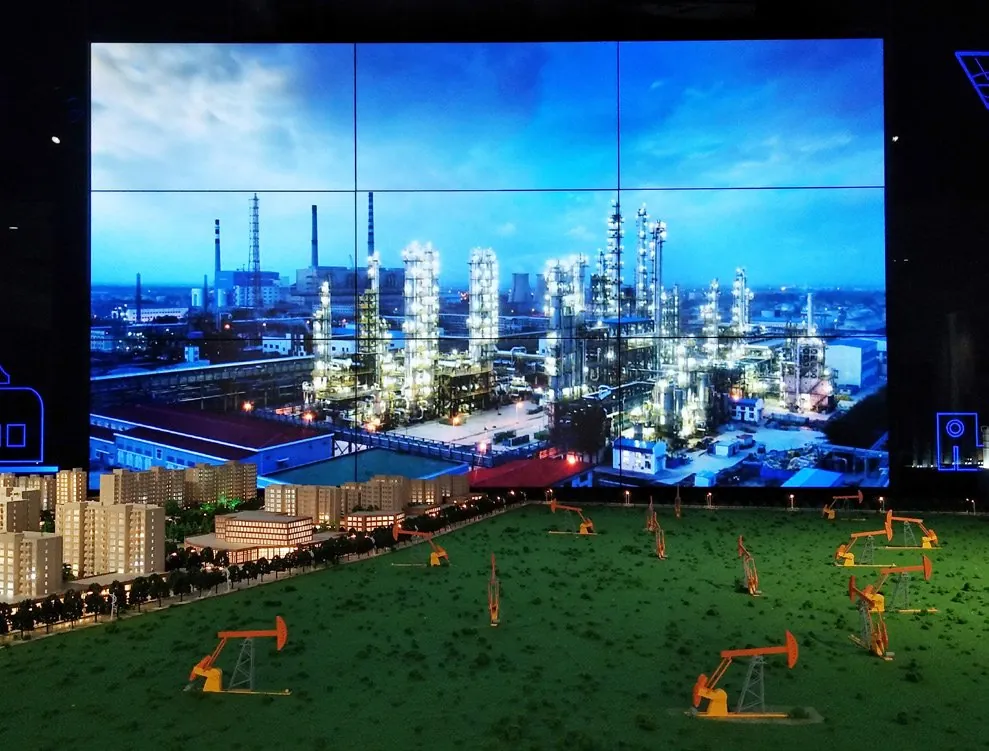
Our video wall project notes describe installed LCD walls, including a coal transaction centre and a science park, and the projects page lists more installations. For public-sector buildings see banks and government, for stations and airports transportation, and for malls retail.
8. Specification checklist for your RFQ
| Item | What to specify |
|---|---|
| Wall size | Width and height of the space; how close the nearest viewer sits |
| Content | Data and cameras, video and brand content, or both; number of sources and windows |
| LCD option | Panel size (46″ / 49″ / 55″), layout such as 3 × 3, seam width 0.88 / 1.8 / 3.5 mm |
| LED option | Pixel pitch, indoor or outdoor cabinet, total resolution |
| Control | Splicing processor or video processor, matrix, control software, inputs |
| Installation | Wall bracket or floor stand; front or rear service; wall load and depth |
| Operation | Hours per day, room light, power supply and cooling |
| Spares and certification | Spare panels or modules; the marks your market requires |
Send it through the contact page and we can quote both options for the same space. The certification guide lists marks by market, and the sourcing guide covers samples, inspection and shipping. Content for either wall can be scheduled with a digital signage CMS.
9. Common mistakes
- Choosing LED for a control room where operators read small text from 2 m, then finding the wall too coarse.
- Choosing LCD for a brand lobby, then placing a seam through the centre of the logo.
- Comparing price per square metre without comparing resolution per square metre.
- Forgetting the processor, matrix and control software in the budget.
- Sizing the power supply from the average LED figure instead of the maximum.
- No spare panels from the same batch, so a replaced LCD panel does not match its neighbours.
Frequently asked questions
What is the difference between an LCD video wall and an LED video wall?
An LCD video wall joins several LCD panels in a grid and shows thin seams between them; ours have 0.88, 1.8 or 3.5 mm seams. An LED video wall is built from LED modules and has no seams; our fine-pitch model has a 1.25 mm pixel pitch.
Which is better for a control room?
Usually an LCD splicing wall with 0.88 or 1.8 mm seams. Operators sit close and read small text and camera feeds, and an LCD wall carries more pixels per metre: a 3 × 3 wall of 55″ panels shows 5760 × 3240.
Is an LED video wall more expensive than an LCD video wall?
At a fine pitch such as 1.25 mm, an LED wall usually costs more per square metre than an LCD splicing wall of the same size. Coarser LED pitches cost less but need viewers further away. Ask for both quotes for your exact wall size.
How far away should viewers be from a P1.25 LED wall?
Our P1.25 display lists a best viewing distance of 1.5–30 m. As a rule of thumb, the minimum comfortable distance in metres is roughly the pixel pitch in millimetres.